Automotive radars for intelligent transportation systems

The solutions are used in driver assistance systems, autonomous driving, robotic vehicles, and intelligent transportation infrastructure.

CAN / Ethernet
ADAS
ACC, BSM
Оbject Tracking

Challenge

A vehicle needs to perceive the road environment in all conditions.

Modern driver assistance and autonomous driving systems must not only detect objects, but also accurately understand their position, speed, and trajectory.

Cameras provide detailed visual information, but they depend on lighting conditions and can be affected by dirt, precipitation, and weather. Ultrasonic sensors are effective at short ranges, but are not suitable for monitoring the road environment at speed.

For safe driving, a vehicle needs a sensor that operates reliably at night, in fog, rain, snow, dust, and complex traffic conditions.

Automotive radar solves this problem by measuring the distance to objects, their relative speed, and direction of movement, and transmitting this data to the vehicle control system.

Solution

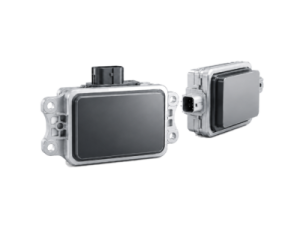
Radar Module for ADAS and Autonomous Transportation

We develop automotive radar systems for installation in the front, rear, and side areas of a vehicle.

The radar generates data about the road scene: it detects moving and stationary objects, measures distance and speed, tracks targets, and transmits the results to the vehicle’s electronic architecture.

The system can be used as a standalone sensor or as part of an integrated perception platform together with cameras, LiDARs, ultrasonic sensors, and a central computing unit.

The solution can be adapted to a specific application: a long-range front radar, a corner radar for blind spot monitoring, a short-range radar for parking, or a multi-radar surround-view system.

Key Features
Frequency range

76-81 GHz

Supply voltage

12/24V

Detection range

up to 250 m

Interfaces
  • CAN
  • Ethernet
Functions
  • ACC
  • FCW
  • RCTA
  • LCA
  • BSM
Compliance with regulatory requirements

Developed in accordance with

  • ETSI EN 301 091
  • ETSI EN 302 264
  • ISO 26262
  • ISO/SAE 21434
  • EMC requirements

FAQ

Frequently Asked Questions

Can the radar be customized for a specific platform?

Yes. The hardware configuration, antenna system, communication interfaces, processing algorithms, and output data format can be adapted to meet the project requirements.

What data is transmitted by the radar?

The radar can transmit a list of objects, target coordinates, relative speed, direction of movement, tracking data, a point cloud, and diagnostic information.

Is it possible to use multiple radars on one vehicle?

Yes. Multiple radar modules can be installed around the perimeter of the vehicle to create radar coverage around the vehicle.

What is the difference between radar and a camera?

A camera captures images, while radar measures the distance to objects and their speed. Radar is less dependent on lighting and weather conditions, which makes it a reliable sensor for active safety systems.

What is an automotive radar used for?

For driver assistance and autonomous driving systems, including adaptive cruise control, automatic emergency braking, blind spot monitoring, parking assistance, collision warning, and surround-view systems.

What is automotive radar?

Automotive radar is a sensor that uses radio waves to detect objects around a vehicle and measure their parameters, such as distance, speed, and direction of movement.